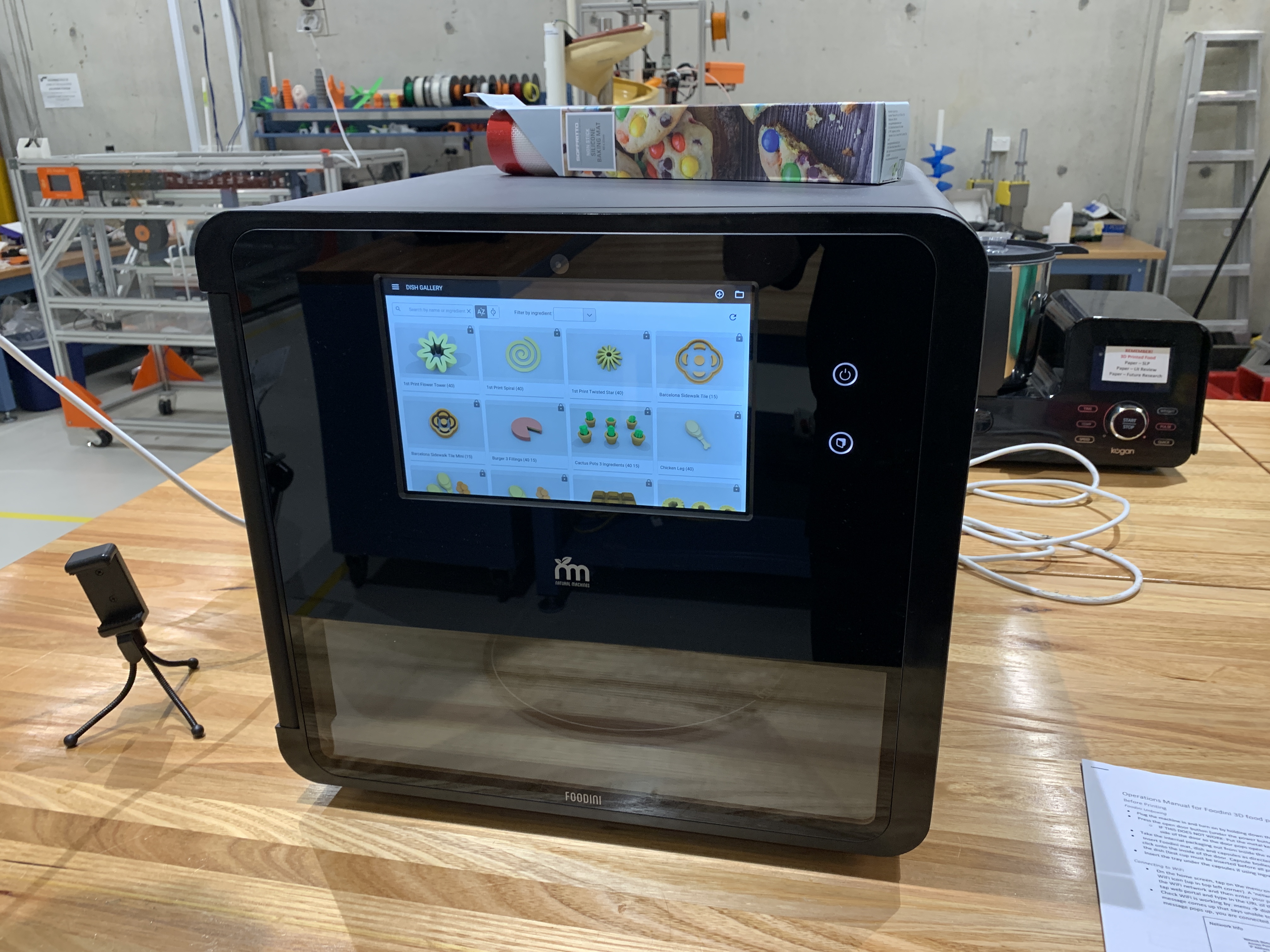
This project aims to identify ways that 3D food printing (additive manufacturing using real food in a device like a ink-jet printer) could be used to improve the visual appeal of puree meals for people with swallowing difficulty, who make up ~8% of the world’s population. This study will include people with and without swallowing disability (e.g., related to cerebral palsy, stroke, older age) and their supporters in examining the views and experiences of stakeholders on the impact of 3D food printing on quality of life, enjoyment, participation, and safety. Outcomes include new knowledge on factors affecting the implementation of 3D food printing in disability and aged care services, to inform policy, practice, and future research.
Publications So Far:
The full length paper on which the slides are based presents a systematic review of 3D food printing for people with swallowing disorders. Lots of claims – little evidence, and no safety research – read it here.
| Title: | Review Informing the Design of 3D Food Printing for People with Swallowing Disorders: Constructive, Conceptual, and Empirical Problems |
| Authors: | Hemsley, Bronwyn Palmer, Stuart Kouzani, Abbas Adams, Scott Balandin, Susan |
| Keywords: | Advances in Design Science Research Organizational Systems and Technology Dysphagia, 3D printing, 3D printed food, Design |
| Date Issued: | 08 Jan 2019 |
| Abstract: | The aim of this review was to examine 3D food printing literature, its focus on problems and solutions, and its capacity for problem-solving in relation to the provision of texture-modified food for people with swallowing disorders (dysphagia). In June 2016 and 2018 the first and fourth authors searched 4 scientific databases with the key terms in 3D food printing and dysphagia to locate relevant peer reviewed journal articles for review. In total, 16 papers were included, and examined for: (a) problems, solutions, and potential for problem-solving capacity expressed in 3D food printing literature to date, and (b) applications of 3D printed foods in specific populations with swallowing disorders. Future research and development of 3D food printing technologies could consider empirical and conceptual problems, along with the multi-dimensional nature of special nutritional or swallowing needs. Taking these issues into account would facilitate the translation of findings into real-world outcomes and benefits. |
| Pages/Duration: | 10 pages |
| URI: | http://hdl.handle.net/10125/60009 |
| ISBN: | 978-0-9981331-2-6 |
| DOI: | 10.24251/HICSS.2019.692 |
| Rights: | Attribution-NonCommercial-NoDerivatives 4.0 International https://creativecommons.org/licenses/by-nc-nd/4.0/ |
| Appears in Collections: | Advances in Design Science Research |
 3D printed food project